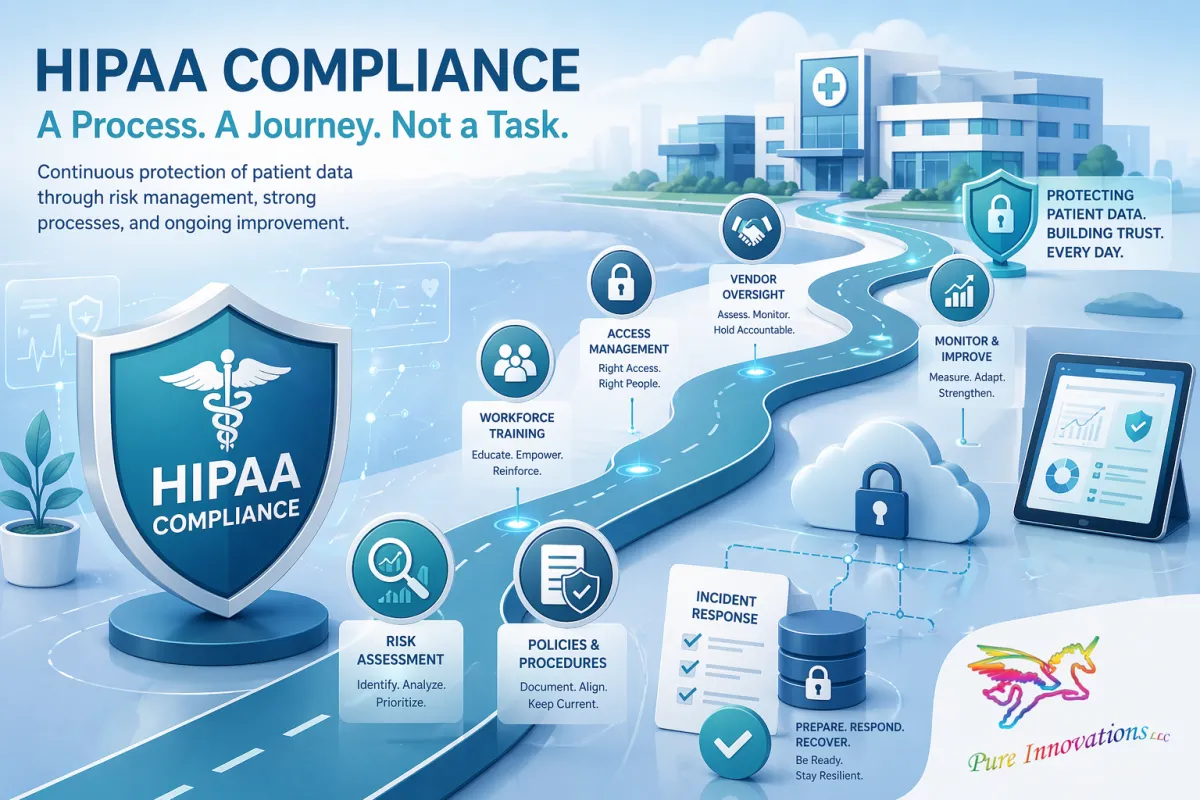
HIPAA Compliance Is a Journey
HIPAA compliance is often misunderstood as a project with an end date. A practice updates a few policies, runs annual training, signs some vendor agreements, and feels done. But that mindset does not match how HIPAA actually works. The HIPAA framework includes the Privacy Rule, Security Rule, and Breach Notification Rule, each of which imposes ongoing responsibilities on covered entities and business associates rather than a one-time certification event.
That is why HIPAA compliance should be treated as a process and a journey, not a task. The Security Rule is especially clear that organizations must implement administrative, physical, and technical safeguards to protect electronic protected health information, or ePHI. Those safeguards are not static. They must evolve as systems change, vendors change, workforce behavior changes, and cyber threats change. HHS guidance also emphasizes that risk analysis and risk management are foundational parts of Security Rule compliance, and that they are ongoing processes.
The checkbox mindset fails because healthcare environments are always moving. New software gets deployed. Staff roles shift. Remote access expands. Mobile devices multiply. Third-party vendors gain access to sensitive data. A policy that made sense eighteen months ago may not reflect today’s workflows, and a training module from last year may not address today’s risks. HHS OCR’s audit materials focus on processes, controls, and policies, which is a strong reminder that regulators look beyond whether a document exists and examine whether an organization is actually managing compliance in practice.
At the center of the journey is risk analysis. OCR’s guidance states that conducting a risk analysis is the first step in identifying and implementing safeguards that comply with the Security Rule. In practical terms, that means organizations should know where PHI and ePHI live, who can access them, how they move, what could go wrong, and what controls are in place. Just as important, risk analysis is not the finish line. Once risks are identified, organizations are expected to manage them to a reasonable and appropriate level.
A mature HIPAA program usually has several recurring motions. It includes regular risk assessments, periodic policy reviews, workforce training, access reviews, incident response preparation, documentation discipline, and vendor oversight. Administrative safeguards under HIPAA explicitly include items like security management processes and workforce-related controls, which is one reason “set it and forget it” compliance is so risky. The most resilient organizations build repeatable habits instead of relying on occasional cleanup efforts.
Vendor management is another reason HIPAA is a journey. Many healthcare organizations depend on cloud platforms, EHR tools, communications vendors, billing partners, and managed service providers. HIPAA requires appropriate business associate agreements when a vendor is creating, receiving, maintaining, or transmitting PHI on behalf of a covered entity or business associate. But the compliance obligation does not end when the agreement is signed. HHS guidance explains that covered entities must take reasonable steps if they know a business associate has materially breached its obligations. In other words, vendor oversight is operational, not ceremonial.
Incident readiness also turns compliance into a continuous discipline. The Breach Notification Rule requires notification following a breach of unsecured PHI, and HHS has also published ransomware-specific guidance for HIPAA-regulated entities. That means organizations need more than privacy language on paper. They need practical response plans, decision paths, escalation processes, and the ability to determine what happened, what data was affected, and what notifications may be required. A team that only thinks about HIPAA after an incident is already behind.
The journey mindset is even more important because healthcare cyber risk keeps changing. HHS has published healthcare cybersecurity performance goals to help organizations prioritize high-impact practices, and OCR issued a proposed update to the HIPAA Security Rule on December 27, 2024, aimed at strengthening cybersecurity protections for ePHI. Even without waiting for future rule changes, the message is clear: compliance programs must keep pace with the real threat environment, not just the minimum wording in an old binder.
So what does a healthier approach look like? It starts by treating HIPAA as part of operations, governance, and risk management. Leadership should know where the organization stands. Technical teams should know the highest-priority risks. Compliance and privacy leaders should have a review cadence. Workforce members should receive training that reflects actual workflows. Vendors should be classified, monitored, and documented. And when incidents or process changes occur, the compliance program should learn from them instead of merely absorbing the damage. This is how organizations move from reactive compliance to durable compliance.
Smaller organizations do not need to solve everything at once. HHS and ONC provide a Security Risk Assessment Tool designed to help healthcare providers work through the risk analysis process, and NIST SP 800-66 Revision 2 offers practical implementation guidance for the HIPAA Security Rule. Those resources are useful because they support the idea that progress matters. A strong compliance journey is built through consistent review, documented decisions, prioritized remediation, and steady improvement over time.
In the end, HIPAA compliance is not about reaching a mythical state of being permanently finished. It is about building an organization that can repeatedly identify risk, protect patient information, adapt to change, and respond responsibly when something goes wrong. The organizations that understand this are usually not the ones asking, “Are we done?” They are the ones asking, “How do we keep getting better?”
For More Information:
Guidance on Risk Analysis Requirements under the HIPAA Security Rule — This HHS page explains why risk analysis is a core part of HIPAA Security Rule compliance. It helps show that protecting patient data starts with understanding where risks exist and managing them over time. — https://www.hhs.gov/hipaa/for-professionals/security/guidance/guidance-risk-analysis/index.html
HIPAA Security Rule Guidance Material — This is HHS’s main guidance hub for HIPAA Security Rule materials. It brings together practical resources on safeguards, risk management, and other ongoing compliance responsibilities. — https://www.hhs.gov/hipaa/for-professionals/security/guidance/index.html
Summary of the HIPAA Security Rule — This official HHS overview summarizes the HIPAA Security Rule in plain language. It is useful for understanding the ongoing administrative, physical, and technical safeguards required to protect electronic PHI. — https://www.hhs.gov/hipaa/for-professionals/security/laws-regulations/index.html
Summary of the HIPAA Privacy Rule — This HHS page provides a clear overview of the HIPAA Privacy Rule. It helps explain how patient information may be used and disclosed, and why privacy compliance is an ongoing responsibility. — https://www.hhs.gov/hipaa/for-professionals/privacy/laws-regulations/index.html
Breach Notification Rule — This official HHS resource explains the HIPAA Breach Notification Rule. It is important because it outlines what organizations must do when unsecured protected health information is exposed. — https://www.hhs.gov/hipaa/for-professionals/breach-notification/index.html
Business Associate Contracts and Other Arrangements — This HHS page explains business associate agreements and vendor responsibilities under HIPAA. It supports the point that compliance does not stop once a contract is signed. — https://www.hhs.gov/hipaa/for-professionals/covered-entities/sample-business-associate-agreement-provisions/index.html
Audit Program — This HHS audit program page shows how regulators review HIPAA compliance in practice. It is helpful because it reinforces that organizations are evaluated on real processes and controls, not just paperwork. — https://www.hhs.gov/hipaa/for-professionals/compliance-enforcement/audit/index.html
Security Risk Assessment Tool — This is a practical Security Risk Assessment Tool from ONC and HHS. It is especially helpful for smaller healthcare organizations that need a structured way to work through HIPAA security risks. — https://www.healthit.gov/privacy-security/security-risk-assessment-tool
Implementing the Health Insurance Portability and Accountability Act (HIPAA) Security Rule: A Cybersecurity Resource Guide — This NIST publication gives practical guidance for implementing the HIPAA Security Rule. It helps translate HIPAA requirements into security practices organizations can actually use. — https://csrc.nist.gov/pubs/sp/800/66/r2/final
HIPAA Security Rule Notice of Proposed Rulemaking — This HHS page explains the proposed HIPAA Security Rule updates announced in late 2024. It helps show why HIPAA compliance should be treated as a living process that evolves with cybersecurity risks. — https://www.hhs.gov/hipaa/for-professionals/security/hipaa-security-rule-nprm/index.html


